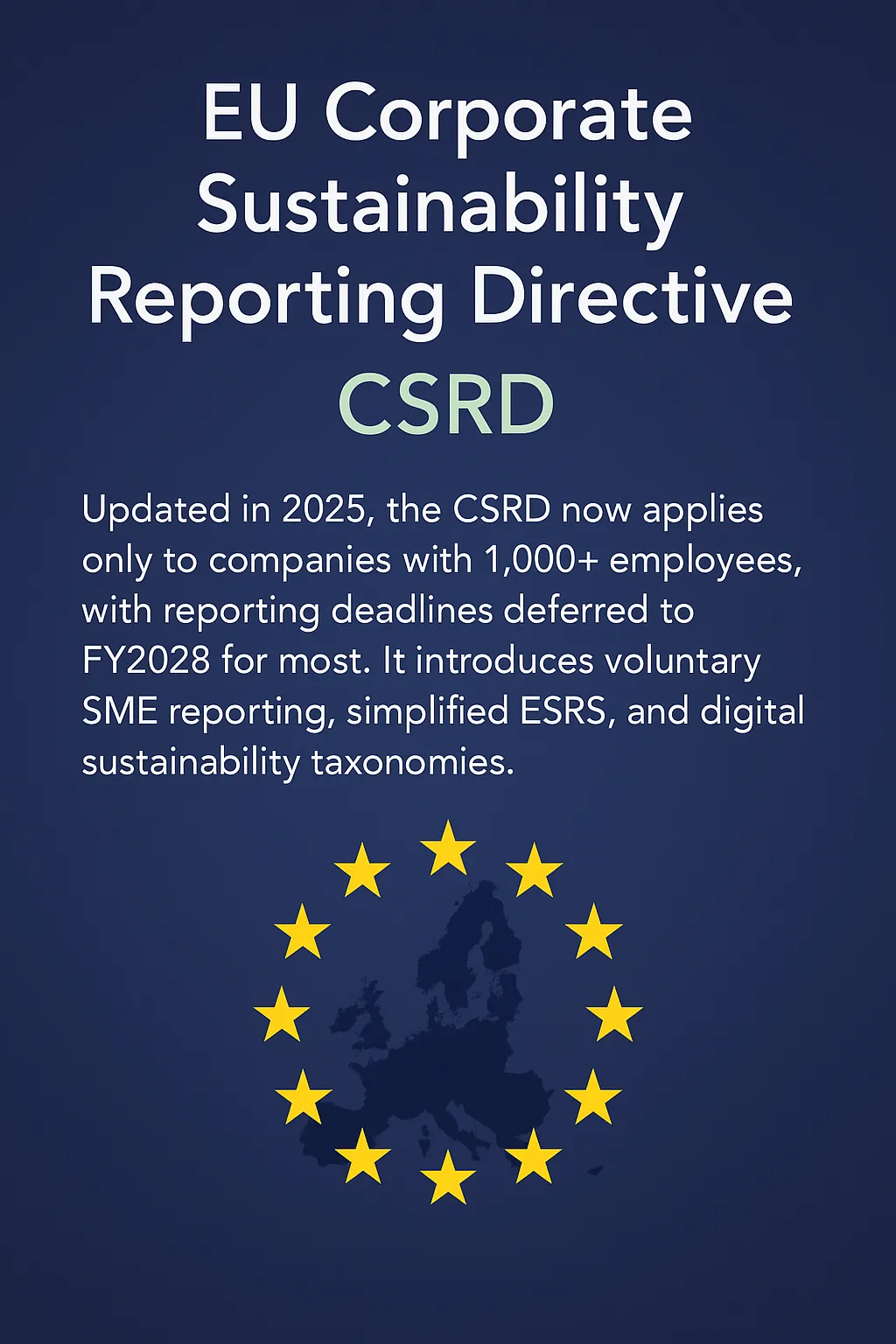
Update (September 2026): Omnibus I (Directive (EU) 2026/470, in force 18 March 2026) reset the CSRD: scope is now more than 1,000 employees and more than EUR 450 million net turnover, newly in-scope companies report first on FY2027, listed SMEs are out, and companies under 1,000 employees cannot be asked by customers for more than the VSME standard. The revised ESRS were adopted on 3 July 2026 and, absent objection, enter into force on 10 November 2026.
The re-baselined picture, with the FY2026 options: CSRD After the Omnibus.
CSRD Permitted Reporting Exemptions
Last Updated: May 2025
The EU’s 2025 Omnibus Simplification Package introduced significant updates to the Corporate Sustainability Reporting Directive (CSRD), reducing compliance burdens and redefining who must report.
Key changes include:
- 📉 80% fewer companies in scope (threshold raised to 1,000+ employees)
- 📅 Reporting deferred for many until FY2028
- 🛡️ Voluntary SME standard (VSME) to limit trickle-down disclosure demands
- 🔄 Taxonomy reporting now optional for companies with <€450M turnover
- 🗂️ Sector-specific standards removed
- 🔍 Only limited assurance required—no upgrade to reasonable
🧾 Updated Exemptions Breakdown
1. Scope Reduction
Only companies with more than 1,000 employees and either €50M+ turnover or €25M+ in assets are now required to report.
2. Reporting Deferral (Wave 2 & 3)
Newly in-scope companies and listed SMEs begin reporting in FY2028.
3. VSME Voluntary Standard
SMEs outside CSRD scope can adopt a simplified voluntary standard that shields them from excessive data requests from CSRD-reporting companies.
4. Subsidiary Exemption
A subsidiary is exempt if its parent publishes a CSRD-compliant, consolidated report and references the exemption.
5. Confidentiality
Sensitive info may be withheld with justification—except for material environmental/social impacts.
6. Voluntary Taxonomy Reporting
Optional for companies with <€450M turnover. Partial disclosures are allowed to reflect transition efforts.
7. No Sector-Specific Standards
All companies use general ESRS. Sector-specific standards will no longer be developed.
8. Simplified Assurance
Only limited assurance applies. The proposal to allow reasonable assurance was removed.
9. First-Time Reporters
May use a phased implementation approach in the first year.